AI, Policy, and Drug Discovery: Key Takeaways from JP Morgan’s 2026 Healthcare
The 44th annual J.P. Morgan Healthcare Conference in San Francisco (February

Tuesday, July 7, 2026 — Universal Press Wire report
AI, Policy, and Drug Discovery: Key Takeaways from JP Morgan’s 2026 Healthcare Conference
Introduction: The Conference That Set the 2026 Agenda
On February 5, 2026, more than 10,000 executives, investors, policymakers, and innovators packed the Westin St. Francis Hotel in San Francisco for the 44th annual J.P. Morgan Healthcare Conference — the industry’s largest and most influential healthcare investment event. This year’s gathering felt distinctly different from prior years. The cautious tone of the post-pandemic era had given way to a palpable sense of urgency and optimism, driven by three transformative trends: the emergence of AI as a force multiplier for drug discovery, a government-led push for a unified health tech ecosystem for Medicare enrollees, and accelerating adoption of virtual care for chronic disease management.
“We saw exceptionally strong momentum in the fourth quarter of 2025, and that energy is carrying directly into 2026,” said Jeremy Meilman, head of healthcare investment banking at J.P. Morgan, during a packed morning session. “Deal flow, partnership announcements, and capital deployment all point to a market that is ready to move.”
Alexei Gogolev, managing partner at a leading healthcare-focused venture capital firm, added a cautionary note: “New AI entrants are reshaping the competitive landscape. Traditional pharma companies that don’t embrace computational biology now will find themselves locked out of the next wave of innovation within 18 months.”
The conference served as a lens through which the entire healthcare value chain could be examined — from lab bench to bedside, and from federal policy to patient wallet. Below are the key takeaways that will shape the industry’s trajectory through 2026 and beyond.
[IMAGE: Wide shot of the conference floor with attendees and branded booths, J.P. Morgan logo visible on stage screens.]
Nvidia & Eli Lilly: Building the AI Drug Discovery Lab
The single most impactful announcement at the conference was the strategic partnership between Nvidia and Eli Lilly to create a dedicated AI drug discovery lab. Under the agreement, Nvidia will deploy its latest GPU computing clusters and its Clara AI platform — originally designed for medical imaging — directly into Eli Lilly’s drug development pipeline. The collaboration aims to build a fully integrated in silico drug discovery engine that can simulate molecular interactions, predict toxicity, and design novel compounds for chronic and rare diseases.
“This is not just another licensing deal,” said a senior Eli Lilly R&D executive during a fireside chat. “We are co-locating Nvidia engineers with our medicinal chemists and biologists inside the same lab. The goal is to cut preclinical timelines by 40% and reduce the cost of early-stage candidate identification by 60% within two years.”
Implications for the Pharma R&D Supply Chain
The Nvidia-Eli Lilly partnership represents a fundamental shift in how pharmaceutical research and development is organized. Traditionally, drug discovery relies on trial-and-error screening of millions of molecules in wet labs — a process that takes an average of four to six years before a candidate even enters Phase I trials. By embedding AI at the inception point, researchers can now model molecular behavior, binding affinities, and off-target effects entirely on computers, validating only the most promising candidates in the lab.
This shift has profound implications for the pharma supply chain:
- Shortened preclinical timelines: In silico modeling can compress target identification and lead optimization from years to months.
- Lower failure rates: AI can predict toxicological risks earlier, reducing the likelihood of late-stage clinical failures.
- Capital efficiency: Smaller biotechs can now access computational tools that were previously the domain of mega-cap pharma, democratizing innovation.
Nvidia’s healthcare push has evolved from its earlier focus on medical imaging (radiology, pathology) into early-stage R&D, a much larger market. The company now positions itself as an essential infrastructure provider for the entire drug development lifecycle. For Eli Lilly, the bet is strategic: with blockbuster drugs like Mounjaro (tirzepatide) driving revenue growth, the company needs a robust pipeline to replace future patent expirations. AI-powered discovery could unlock novel targets for chronic and rare diseases — areas where traditional high-throughput screening has struggled.
[IMAGE: Concept art of a high-tech lab with holographic molecule simulations and server racks in the background, Nvidia and Lilly logos visible on screens.]
Government’s Call for a ‘Health Tech Ecosystem’ for Medicare
While private-sector AI deals dominated the headlines, a parallel narrative emerged from the policy track of the conference. Senior officials from the Department of Health and Human Services and the Centers for Medicare & Medicaid Services (CMS) made a coordinated push for what they termed a “unified health tech ecosystem” for Medicare enrollees.
In a keynote address, the CMS deputy administrator for innovation emphasized that the current patchwork of health records, telehealth platforms, and remote monitoring devices is failing the 65-million-strong Medicare population. “We are spending billions on technology that doesn’t talk to each other,” she said. “A patient’s blood pressure data from a home monitor should flow seamlessly to their primary care doctor, their specialist, and the hospital — but today, it sits in a silo.”
What a Unified Ecosystem Means in Practice
The government’s vision includes three core components:
- Interoperability standards: Mandating that all Medicare-contracted providers and technology vendors adopt FHIR (Fast Healthcare Interoperability Resources) standards for real-time data exchange.
- Data-sharing incentives: Providing federal reimbursement bonuses for health systems that demonstrate meaningful integration of patient-generated health data (PGHD) from wearables and home monitoring devices.
- Telehealth and remote monitoring expansion: Permanently extending COVID-era telehealth flexibilities and creating new Medicare reimbursement codes for continuous remote monitoring of chronic conditions.
The economic logic is clear: Medicare is the largest single payer in the United States, covering roughly 20% of the population but accounting for over 30% of healthcare spending. A significant portion of that spending — particularly hospital readmissions and emergency department visits — stems from poorly managed chronic conditions that could be addressed through better data integration and remote care.
This policy push could catalyze a new wave of digital health adoption. Startups and established health tech companies that have struggled to gain traction in a fragmented market will find a clear regulatory path and a massive, stable revenue source through Medicare reimbursement. For investors, this represents a multi-billion-dollar opportunity in platforms that connect home devices, electronic health records, and care coordination workflows.
[IMAGE: Infographic showing secure data flow between Medicare, hospitals, home monitoring devices, and cloud-based health platforms.]
Virtual Care in Chronic Disease: Scaling Beyond the Pandemic
A third major theme at the conference was the maturation of virtual care — but with a critical twist. Rather than the broad, general-purpose telehealth visits that surged during the pandemic, the 2026 conversation focused squarely on virtual care for chronic disease management: diabetes, hypertension, heart failure, and chronic obstructive pulmonary disease (COPD).
“We now have randomized controlled trial data showing that structured virtual care programs for diabetes reduce HbA1c by 1.2% more than usual care, and for heart failure, they cut 30-day readmission rates by 32%,” said the chief medical officer of a leading virtual care platform during a panel discussion. “The question is no longer whether virtual care works — it’s how to scale it cost-effectively.”
AI as the Operating System for Virtual Care
The scalability challenge is being solved by layering artificial intelligence onto virtual care platforms. Predictive analytics can identify patients at high risk of decompensation before they become symptomatic. Chatbots and conversational AI handle routine triage, medication adherence reminders, and symptom logging, freeing up clinicians for higher-value interventions. Remote monitoring devices — from continuous glucose monitors to smart blood pressure cuffs — stream data into algorithms that automatically adjust care plans.
This convergence of AI and virtual care creates a powerful feedback loop: more data leads to better algorithms, which leads to better outcomes, which attracts more patients and providers to the platform. Several companies at the conference showcased products that combine FDA-cleared digital therapeutics with AI-driven coaching, effectively creating a new category of “prescription digital care.”
Policy Tailwinds Align
The government’s push for a unified health tech ecosystem directly supports this trend. When Medicare mandates interoperability and expands reimbursement for remote monitoring, it removes the two biggest barriers to adoption: lack of integration and lack of payment. Chronic disease management accounts for 90% of the nation’s $4.5 trillion in annual healthcare spending. Even a modest reduction in hospitalizations and complications through virtual care could save the system tens of billions of dollars.
For providers, the economics are compelling. Hospital systems are increasingly adopting virtual chronic care programs not just for patient outcomes but for margin improvement. A well-run virtual diabetes program, for example, can reduce expensive emergency visits while generating steady monthly reimbursement from Medicare and commercial payers. Several large health systems announced multi-year partnerships with virtual care vendors during the conference.
[IMAGE: A patient using a tablet to consult with a doctor, with real-time vitals displayed on screen; subtle AI icons in the background indicating automated analysis.]
M&A Momentum: A Dealmaking Supercycle Emerges
Beyond the three thematic pillars, a consistent undercurrent at the conference was the strength of mergers and acquisitions. J.P. Morgan’s own data showed that healthcare M&A activity in the fourth quarter of 2025 reached the highest level since 2021, with total deal value exceeding $180 billion. The momentum is continuing into 2026, driven by low borrowing costs relative to recent years, large private equity dry powder, and strategic urgency among pharma companies to acquire AI capabilities.
“We’re seeing a watershed moment where big pharma is willing to pay premium multiples for tech-enabled biotech platforms, not just for late-stage pipeline assets,” noted an M&A banker on a panel. “If you have a platform that combines AI-driven drug discovery with a clinical-stage asset, you’re in the driver’s seat.”
Notable announced or rumored transactions discussed at the conference included large-cap pharma acquisitions of mid-cap AI-native biotechs, health system consolidations in the Midwest, and several take-private deals for undervalued digital health companies. The convergence of AI, policy, and virtual care is creating a deal environment where scale matters more than ever — and the window for smaller players to be acquired may be narrowing.
What These Shifts Mean for Investors, Providers, and Patients
The 2026 J.P. Morgan Healthcare Conference painted a picture of an industry in transition. For investors, the message is clear: traditional pharma investment frameworks that ignore AI will underperform. The next generation of blockbuster drugs will be discovered in silico, not in random screening assays. Similarly, digital health companies that can demonstrate Medicare-ready interoperability and outcomes data will command premium valuations in both public and private markets.
For providers, the imperative is to prepare for a data-rich, AI-assisted future. Hospital systems that invest in interoperable EHRs, virtual care platforms, and analytics teams now will be the ones that thrive under value-based payment models. Those that delay risk being disrupted by tech-forward competitors (including retailer-owned clinics and virtual-first insurers) that are already building the health tech ecosystem the government envisions.
For patients — especially the 65 million Medicare beneficiaries — these changes could mean more convenient, more effective, and potentially cheaper care. The combination of AI-accelerated drug development, unified health data, and virtual chronic disease management holds the promise of catching diseases earlier, reducing side effects from poorly chosen drugs, and keeping people out of the hospital.
But challenges remain. Data privacy, algorithmic bias, and the digital divide must be addressed to ensure that AI and health tech benefit all populations, not just the well-insured and tech-savvy. The conference did not shy away from these issues; multiple sessions were dedicated to responsible AI governance and health equity.
Looking Ahead: The 2026 Agenda Takes Shape
As the final sessions concluded and attendees headed for the hotel’s lobby bars, the sense was that healthcare had entered a new era. The convergence of AI with pharmaceutical R&D, the government’s tactical push for data integration, and the maturing of virtual care are not separate trends — they are interconnected forces that will accelerate one another throughout 2026 and beyond.
The Nvidia-Eli Lilly partnership may be the most visible deal of the conference, but its real significance is as a signal: the walls between tech and pharma have crumbled. In the years ahead, the most valuable healthcare companies will be those that master the intersection of biology, computation, and policy. The 44th J.P. Morgan Healthcare Conference was the venue where that future became unmistakably clear.
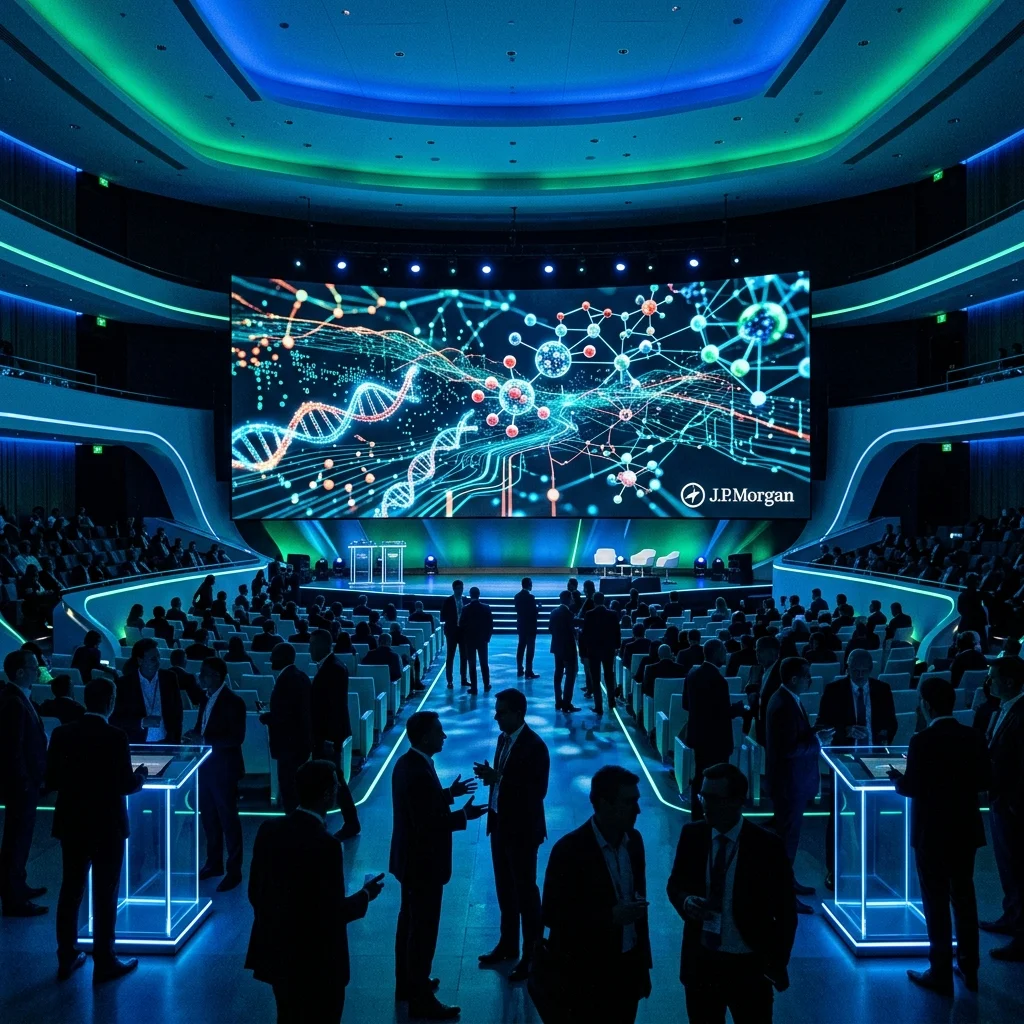
[IMAGE: A futuristic conference hall with a large screen displaying interconnected data streams and molecular structures, with a subtle J.P. Morgan logo in the corner. In the foreground, silhouettes of businesspeople networking. Illuminated podiums and glowing blue and green tones.]
Press Release Notice
Some materials are supplied by third-party organizations as press releases or announcements. Responsibility for their claims, accuracy and rights remains with the issuing party, and publication does not constitute endorsement by Universal Press Wire.
Keywords & Tags

